One Service Counter or Several? Reading the Trade-Off
One service counter or several can shape how easily residents get help. Learn which setup fits clear requests, complex cases, and careful handoffs.
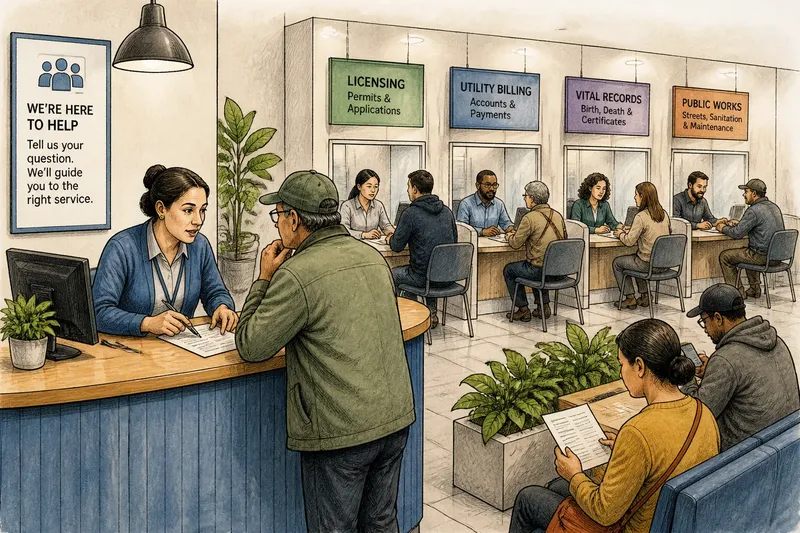
At a city service center, a resident with a parking question may spot one counter for every request—or separate desks for permits, bills, and records. One service counter or several can change how quickly people identify the right place, explain a problem, and reach someone able to act. The better arrangement depends on what residents ask and how much coordination the answer requires.
1. What does one counter make clearer?
A single counter gives residents one obvious starting point. Someone who is unsure whether a request belongs to sanitation, street maintenance, or a neighborhood office can begin without learning the city’s internal chart. Staff can clarify the issue and direct it to the responsible team.
This design is especially useful when people make varied requests and do not know the service names. It can also help a first-time visitor who has a form, a bill, or a question but cannot tell which department handles it. The resident need not guess among several signs before speaking with anyone.
The trade-off is that the first staff member may not be able to resolve the request. If the counter works only as a greeting point, residents may explain the same issue again after being referred elsewhere. A clear entrance is helpful, but only if staff can make a useful handoff rather than simply point down a hallway.
2. When do separate desks suit the question?
Dedicated desks can work well for services with distinct forms, rules, and staff expertise. A licensing desk, for instance, may need to review an application and explain missing documents. A separate utility-billing desk may handle account questions that require access to different records.
When the request is familiar and narrowly defined, a labeled desk can reduce uncertainty: visitors who know they need a birth-record copy can head to vital records rather than describe the request at a general counter. Staff can also keep the forms and reference materials relevant to that service close at hand.
But divisions that make sense to employees may not match a resident’s situation. A person reporting a damaged sidewalk while asking about a nearby construction permit could face two desks, even though the concerns involve the same location. Separate desks are most useful when signs describe what residents can do there, not just the name of the department.
3. How do handoffs affect the visit?
A handoff is the point where responsibility moves from one person or team to another. In a one-counter system, a staff member might contact the right department, explain the issue, and tell the resident what happens next. In a system with dedicated desks, the resident may move directly to the specialist, but can still be sent on if the request crosses service lines.
Good handoffs preserve the details a resident has already provided. Staff can note the relevant address, form, or prior contact so the next person does not have to start from the beginning. They should also make clear who is responsible for the next action and how the resident can follow up.
Imagine a resident asking the general counter about a missed recycling pickup and a damaged bin. The clerk identifies the collection team, records both concerns, and gives the resident one contact route for the response. The visible result is a visit in which the resident explains the problem once and leaves knowing what to expect, even if another team handles the work.
4. Which layout fits different kinds of requests?
Think about the request’s shape, not just its department. A straightforward transaction—such as collecting a document that is ready—may fit a dedicated desk. A question that could belong to several departments may be easier to start at a shared counter. A complex case may need a named staff contact rather than a quick referral between desks.
A useful distinction is whether a person needs information, a transaction, or coordination. Information questions often benefit from a knowledgeable front door. Transactions can suit a specialist who can complete the task. Coordination calls for someone who can connect teams and stay accountable for the next step.
Like a building directory, a service layout should help people choose a route; it should not require them to understand how the building is managed behind the scenes. If the directory uses unfamiliar department names, a single welcome point may compensate. If the service labels are plain and the tasks are clearly separated, dedicated desks may be easier to use.
5. What should a resident look for at the counter?
Residents can judge the arrangement by observing whether the first contact produces a clear next move. Look for signs that use everyday terms, staff who ask enough to identify the request, and directions that specify the right desk or contact method. Notice whether people are sent away without knowing what to bring or whom to reach next.
These signs do not prove that one layout is best for every visit. They show where a service may be creating friction: unclear signs point to a wayfinding problem, repeated explanations suggest weak handoffs, and a queue serving unrelated tasks may indicate that the counter is doing too much at once.
What do residents often want to know?
Can one counter answer every city service question?
Usually, one counter is better understood as a starting point than as a place where every request is completed. Its value depends on staff being able to identify the right service and explain the next step.
Are separate desks always faster?
Not necessarily. A specialist desk can suit a familiar transaction, but confusing signs or a request that crosses departments can add extra stops.
What if a request belongs to more than one department?
Ask which team will take the next action and how the other concern will be handled. A useful response identifies responsibility rather than leaving the resident to coordinate the departments alone.
How can I prepare before visiting?
Check the city’s service page or call the listed contact to confirm the right location and any documents to bring. Describe the issue in plain language, including the address or account involved if relevant.
6. What makes the trade-off worth reviewing?
For city staff and decision-makers, the choice is not simply one counter versus several. It is whether the arrangement fits the questions residents bring, the expertise those questions require, and the way cases pass between teams. A single counter can make entry simple; specialist desks can make focused tasks easier. Either can frustrate residents if the signs, referrals, and ownership of follow-up are unclear.
To assess one service counter or several, start with the resident’s route: where they begin, what they must explain, and whether they leave with a specific next action. That practical view can reveal whether a city needs a more welcoming shared entry, better-defined specialist desks, or a stronger connection between the two.