Before City Hall, Public Meetings Took Shape in Shared Civic Spaces
Public meetings before City Hall grew from local needs and available spaces; learn how to read that history without forcing every city into one timeline.
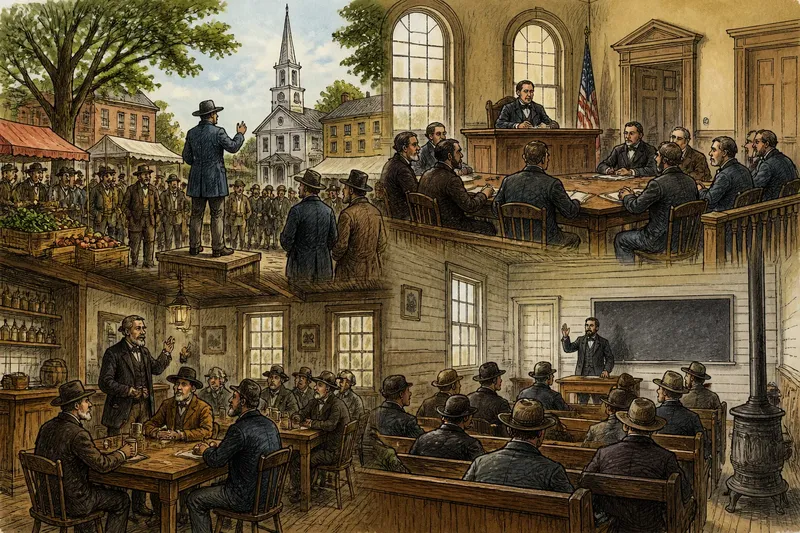
Where did public meetings happen before a city had a municipal hall? Public meetings before City Hall took shape in places residents already used: market squares, courthouses, taverns, schoolrooms, and other shared buildings. The setting depended on local customs, the business at hand, and which rooms a community could actually use.
That history is easier to understand as a set of local choices than as a march from open air to formal government. If you are reading an old town plan, interpreting a civic building, or comparing neighborhoods, start by asking what a meeting needed to accomplish and who could enter the space. Those questions explain more than a single timeline can.
Why did public meetings begin in shared places?
Many communities had no dedicated municipal room. People gathered where civic business, trade, worship, and social life already intersected. A marketplace could bring residents together on a regular day; a courthouse could host hearings as well as local deliberation; a tavern or schoolhouse might offer shelter and a room large enough for a group.
These were not interchangeable venues. An outdoor square made a gathering visible and could accommodate passersby, but weather and noise limited what could be discussed. An indoor room offered shelter and, sometimes, a table, records, or a chairperson’s place. Yet its owner might control access, and its customary use could shape who felt welcome.
Think of a venue as a borrowed tool: useful for a particular job, but shaped by the person who lends it. A community might meet in a courthouse because it was available, not because residents had chosen a lasting civic design. The room’s location and rules still carried meaning.
Which setting fits the history you are trying to understand?
Choose the lens that matches your evidence. A city’s meeting history may include several kinds of space at once, with different venues serving different purposes or groups.
- If you are looking at a small settlement: Check for a shared building or open gathering place rather than assuming a town hall existed. Limited facilities often meant civic business borrowed a space already used for commerce, worship, or local administration.
- If the records describe a courthouse or council room: Treat the venue as a sign of more formal procedure, not proof that every resident had equal access. Ask who controlled the building and whether the room hosted only official business or other gatherings too.
- If you are studying a growing town: Look for overlapping arrangements. A council might meet indoors while announcements or public discussion happened elsewhere; growth did not necessarily move every civic activity into one building.
- If you are comparing places: Compare local functions and access rather than ranking cities by which built a municipal hall first. Similar-looking buildings can reflect different needs, political arrangements, and traditions.
Say you are examining an invented town whose council records mention meetings above a market while a courthouse stands nearby. The records name the market room as the regular council venue, so you check its location, ownership, and stated purpose before drawing conclusions. The expected result is a more grounded account of why that room served the council, without assuming that the courthouse was unused or that the arrangement matched other towns.
What changed when municipalities built dedicated rooms?
A purpose-built municipal room could make government easier to locate and give officials a setting designed for recurring business. A fixed place might support records, scheduled sessions, and a clearer distinction between public administration and the everyday use of a borrowed venue. It could also signal that local government expected to endure and needed a recognizable home.
But a new building did not automatically replace older gathering places or settle questions of access. Outdoor spaces remained useful for public occasions; schools, courts, and community rooms could continue to host civic activity. Nor does a formal room by itself tell you whether residents could observe proceedings, speak, or influence decisions. Those practices must be read from local rules and records.
The shift was uneven because municipalities faced different conditions. A community with an available public building could formalize its meetings without constructing a new one. Another might establish a dedicated hall as its administration expanded. In some places, official meetings and informal public discussion remained spread across several venues.
How can you read the evidence without forcing one timeline?
Start with records that name places: meeting minutes, notices, building plans, local ordinances, and descriptions of public rooms. A venue mentioned in a record may have changed names or uses, so compare the wording across documents rather than treating one label as definitive.
Then separate three questions: where officials met, where residents gathered, and where members of the public could take part. These locations may have differed. A record that identifies a council chamber establishes a meeting place, but it does not establish who attended or how open the proceedings were.
Also check the broader setting. Was the room attached to a courthouse, located near a market, or shared with another institution? Did notices direct residents to an outdoor gathering place while formal business took place indoors? Such details can show how local government related to ordinary public life without turning a single building into the whole story.
What should you ask about public meetings before City Hall?
Did every town have a town hall before it had a city hall?
No single pattern fits every place. Some communities relied on shared buildings or open spaces, while others developed dedicated municipal rooms as local needs and resources allowed.
Did public meetings usually happen outdoors?
Outdoor spaces could support gatherings, especially when a community already met there for other purposes. Official business also took place indoors in courthouses, taverns, schools, or rooms set aside for local administration.
Does a purpose-built hall mean meetings became more democratic?
A dedicated room could make government more visible as an institution, but the building alone does not reveal who could attend or speak. Look for local rules, meeting notices, and records of participation before making that judgment.
How can I identify an old meeting place?
Compare place names in minutes, maps, building plans, and public notices, then check whether the site had other uses. Treat an old room’s function as a question to investigate, not something its current name can settle.
What does this history help you notice today?
When you enter a municipal chamber, consider what its arrangement makes easy: finding the meeting, hearing speakers, seeing officials, or consulting records. Then ask what activity still happens in public spaces outside that room. The answer can reveal whether civic life is concentrated in formal institutions or shared among several neighborhood settings.
Public meetings before City Hall were not merely an earlier version of the modern council session. They emerged from the spaces communities had, the institutions they trusted or relied on, and the uses they made of public places. Read each venue in its local context, and the history becomes less a timetable of buildings than a record of how residents organized civic life.