A First Community Meeting, Planned Around Listening
Prepare for a first community meeting with a simple listening plan: understand the topic, choose one question, and learn how the discussion works.
A first community meeting can feel like a room where everyone else already knows the rules. A simple plan for your first community meeting can help you arrive ready to listen, understand the subject, and ask one useful question without feeling obliged to speak for an entire neighborhood.
Think of the meeting as a map you are learning to read, not a performance you must give. Your first visit can be worthwhile even if you leave without speaking. Set aside a little time during the week before the meeting, then use the meeting itself to notice how residents, staff, and elected members take part.
What should you find out first?
Start with the meeting notice, agenda, or public calendar entry. Find the exact topic and the body responsible for discussing it. A neighborhood association, transit committee, planning board, and city council may all hold public meetings, but their roles and formats differ.
Look for practical details that could shape your visit:
- Where the meeting takes place, including the room or building entrance.
- Whether it is in person, online, or offered in both formats.
- When the public may speak and how to sign up, if speaking is allowed.
- Whether the agenda or supporting documents are available in advance.
- Who to contact about access needs, interpretation, or a remote connection.
Use the issuing body’s official notice or contact information to check details. If the topic is governed by a formal procedure, rely on the meeting’s published rules and ask the clerk or organizer for clarification rather than guessing.
Do not try to read every background document. Scan the agenda for the item that matters to you, then note any unfamiliar terms or acronyms. A few clear notes are more useful than a stack of printouts you will not have time to consult.
How can you prepare during the week?
Several days ahead, write the subject in one plain sentence. For example: “The committee is discussing changes to the bus stop on Maple Avenue.” Keep the sentence descriptive. It helps you distinguish the official topic from broader concerns you may have about transportation or neighborhood growth.
Next, identify what you do not yet understand. Choose one question that would help you follow the discussion, not a speech disguised as a question. You might ask how a proposal would affect the stop’s location, which agency maintains the sidewalk, or what happens after the committee makes a recommendation.
Try this routine:
- Several days before: Save the notice and confirm the meeting’s location, format, and start time.
- A few days before: Read the agenda item and write a one-sentence description of its subject.
- The day before: Choose one question that clarifies the proposal or process. Bring paper or a notes app to record the answer.
- Before leaving: Check your route, building access, and any sign-up instructions. Decide how long you can stay.
- Afterward: Write down what you learned, what remains unclear, and where the next update will appear.
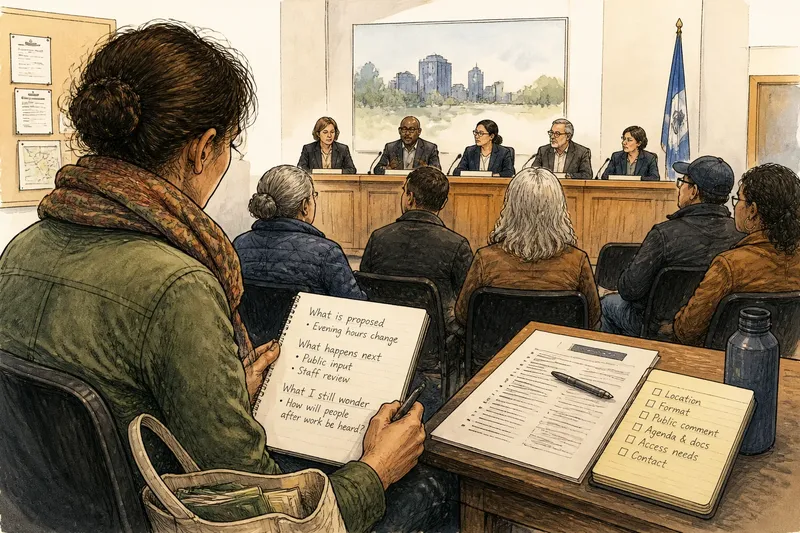
Say you want to understand a proposed change to a branch library’s evening hours. You read the agenda, note that the committee is reviewing service schedules, and prepare one question: “How will the committee hear from people who use the library after work?” At the meeting, you listen for whether the discussion addresses public input and record the next step. You have made a focused visit without needing to present a position on every library issue.
What should you listen for during the meeting?
Arrive with enough time to find the room, settle in, and read any posted agenda changes. If you join online, check that you can hear the discussion and learn how participants signal that they want to speak. These small details can make the room easier to follow.
At the start, notice who is facilitating, who is presenting, and how the agenda moves from one item to another. Listen for distinctions between a proposal, a recommendation, and a final decision. A discussion may involve several bodies, so note which group has authority to act and which is advising another group.
Keep your notes divided into three simple headings: “What is proposed,” “What happens next,” and “What I still wonder.” This keeps observations separate from assumptions. If someone uses a term you do not recognize, write it down and ask for its meaning later instead of interrupting a complicated exchange.
Pay attention to how public participation works in practice. Does the chair invite comments at a particular point? Are questions answered immediately, referred to staff, or recorded for a later response? Do people speak from a microphone, submit written comments, or use an online queue? You are learning the room’s working rhythm, not judging your own performance.
How can you take part without pressure?
Before the meeting, decide what level of participation feels manageable. You might attend only to observe, ask your prepared question if there is a clear opening, or sign up to speak if the process allows and you feel ready. None of these choices is a measure of how much you care.
If you do speak, keep to the point you came to understand. A short question can help you and other residents follow the proposal. If the chair moves on before you get a chance, note the contact route for follow-up. Avoid treating a missed speaking opportunity as a reason to rush into a comment that does not fit the agenda.
It can also help to identify one practical constraint before you go. If you need to leave early, check the agenda order and ask an organizer whether the relevant item is likely to come up near the beginning. If you need an accessible entrance or interpretation, contact the meeting host ahead of time when possible.
What do first-time visitors often want to know?
Do I have to speak at my first community meeting?
No. You can attend to understand the topic, observe the process, and learn where updates are shared. Speaking is only one form of participation, and the meeting’s rules may set specific times or procedures for public comment.
What should I bring to a community meeting?
Bring the agenda, a short list of notes, and a way to record answers, such as a small notebook or phone. If you may speak, keep your question in plain language so you can refer to it without reading a long statement.
What if I do not understand the discussion?
Write down unfamiliar terms and note who used them. You can ask the facilitator or contact the relevant staff member afterward for a plain-language explanation, especially if the conversation moves too quickly to follow.
How do I find out what happens after the meeting?
Check the meeting notice for minutes, recordings, staff contacts, or the next scheduled discussion. Note the name of the responsible committee or department so you can look for an update in the right place.
What should you do after you leave?
As soon as practical, expand your notes while the discussion is still fresh. Separate what you heard directly from what you inferred, and write down any unanswered question. If the meeting named a next action, such as a later vote or a staff report, note where and when you can check for it.
For a first community meeting, the most useful result may be a clearer understanding of who is deciding what, and how residents can follow along. Your one question can reveal the next point to watch; your observations can help you decide whether to return, contact an organizer, or simply keep track of the issue. That is enough to make the next visit feel less like entering a room of strangers and more like knowing where to look.